




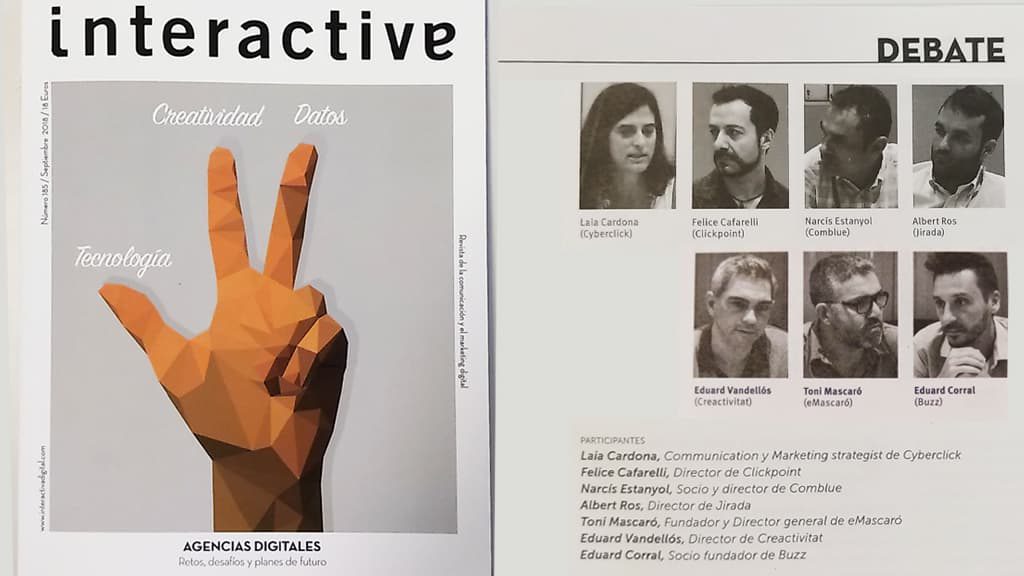
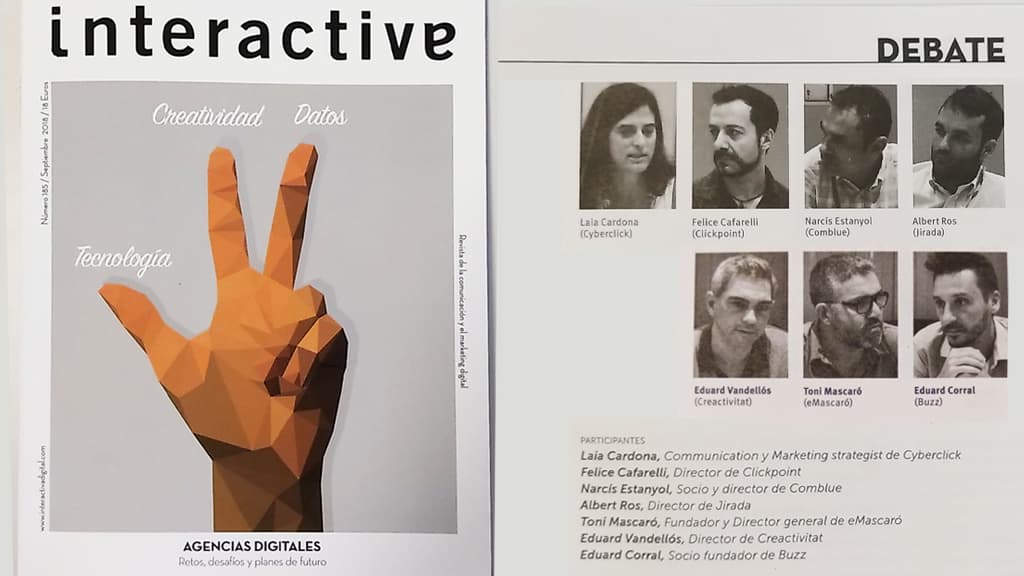
Last September’s interactive magazine brought together seven of Barcelona’s leading digital agencies to discuss innovation, creativity and the spirit of collaboration that prevails in an increasingly competitive sector. Among these agencies was Creactivitat, represented by Eduard Vandelòs, as CEO of the company.
On innovation, Eduard Vandelós argued that the key is to change his client’s idea: “To get them to understand that not everything has always to be measurable results but that from time to time they are allowed to get into beta thinking’s mental states.” Nevertheless, the Director of Creactivitat himself deduces that this is a complex duty if one takes into account the perception that each client can have about the concept: “There are customers for whom innovating can be simply work about the CRM, while others can give him a turn after another as a video gets to the final client.” In this sense Toni Mascaró, as an eMassaro Founding, reflected about the type of company that’s trained to work in innovation: “Today businesses have to be competitive and to be competitive they have to use new technologies, and that’s what they have to bring mature and serious providers, and the client already knows where they are.”
The concept of creativity was another of the considerations that had been put up for discussion among the attendees. For Eduard Vandelós, creativity should be stimulated by liquid and flexible structures: “I don’t have to create departments because everything develops naturally (…) We have an all-life creative that only focuses on creativity, and then it’s others within the agency that implement them to different means and channels.” For his part Eduard Corral, as Founding of Buzz Marketing Networks, deepened the application of the concept to work with customers: “Creativity does have to be an goal but that that that that that allows you to achieve a goal (…) In our case, we have drawn up a list with a number of insights and data (…) and with that information we generate a creativity that does help achieve the targets that the advertiser had set itself.” On this same line, Albert Ros spoke as Jirada’s Executive Director: “We will put on the table a creativity that we have previously been able to atprove to work. What we do not care about is a creativity that’s visually powerful or very occurring but that the final consumer doesn’t understand or connect with.”
The collaboration between agencies and / or freelances was one of the most controversial issues of the day. Narcís Estanyol, as Director of Comblue, argued that his company’s start up mindset forced him to bet on association: “The world is global and it’s impossible to be at all (…) We understand that it’s vital to build partnership with other agencies that can contribute something that you don’t have.” On the opposite side of this argument, Felice Cafarelli, as Clickpoint’s Director, stood: “I’m more of a gambling for people who are with me and work for projects because I need a continuity, and that continuity with freelances is very difficult to achieve.” At an intermediate point to these reflections was Laia Cardona as Research and Marketing Officer at Cyberclick: “We work as a laboratory. We constantly innovate and form and try to get everyone to feel part of every project. Clearly there are specialists (…) and sometimes these specialists have to come from outside and on time, especially in some cases, at the start of a project.”
The common point at which if the seven digital agencies have reached, was the type of relationship that should be promoted between company and client, as they conduct common projects. “Segmentation,” “honesty,” “personalisation,” “confidence” “” familization “and” reputation “have been some of the expressions that have been used by those responsible for these companies to describe a type of success. A conception that, according to Eduard Vandelòs, will only be achieved through pedagogy: “to both client and final consumer.”
Department of Marketing